
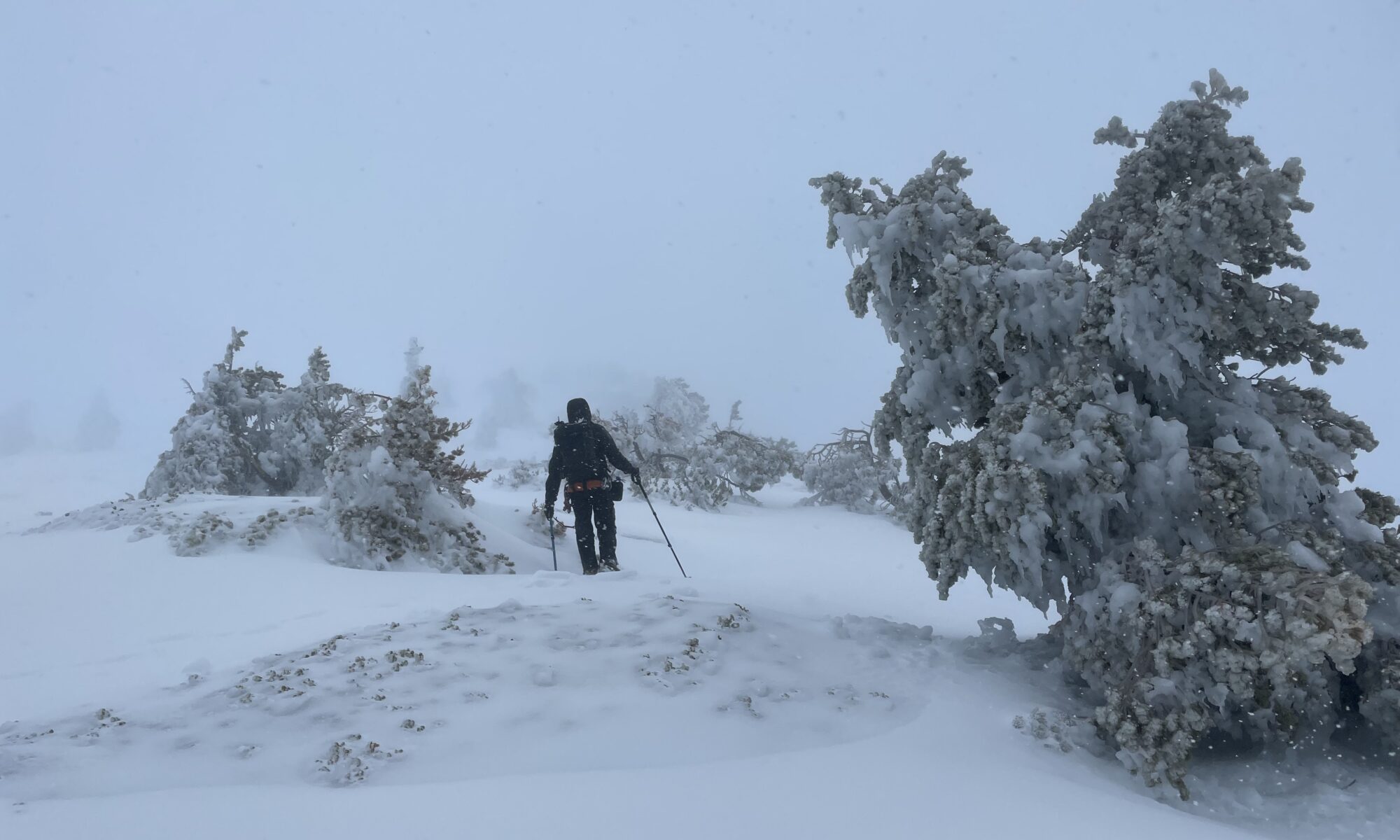
Recent tragic deaths on Mt. Baldy and a jump in the rescues in the higher elevation areas of the San Gabriel, San Jacinto, and San Bernardino mountains have increased efforts to improve mountain safety, especially in the winter months. While there is never zero risk when recreating in our local mountains, venturing into the mountains during the winter increases risks and requires a broader set of equipment, experience, and hazard management strategies.
Most people are familiar with the need for the proper equipment, in particular the need for an ice axe, crampons (worn on appropriate, crampon-compatible footwear), a helmet and other equipment for dealing with harsher weather conditions. The experience to recognize the need for and possessing the training and skills to properly use that equipment should be obvious. What is often overlooked and is just as important in managing risk is our decision-making processes. Central to this is the idea of objective and subjective hazards and factors that influence these factors.
Objective vs Subjective Hazards
Objective “environmental” hazards originate in the mountain environment and exist regardless of our presence. These hazards include things such as steep slopes, avalanches, rockfall, high water levels, unstable weather and many other things. Subjective hazards are all about us and the choices we make or experience, attitude and behaviors we bring to the mountains. Subjective hazards include fitness, skills, equipment, judgment, group dynamics, and behavioral tendencies like summit fever or overconfidence. Unlike objective hazards, we can do something about subjective hazards if we recognize them.
– Many hikers often have the physical ability to ascend the mountain, i.e., they are quite physically fit, but lack mountaineering experience to recognize subjective and environmental hazards – particularly in the winter.
– Over time, acquired experience and feedback (i.e., “lessons learned”) help people better identify both objective risks and their own biases, but experience can also feed familiarity, expert halo, and overconfidence if not checked.
– Heuristic traps are mental “shortcuts” that can help with rapid decision making with limited analysis and are something we need to consider re: subjective risks. Heuristics usually help decisions feel fast and easy but can subconsciously push people toward poor choices in complex, high‑consequence environments like avalanche terrain, snow covered slopes or remote trails. These traps often involve group dynamics – both in-person (i.e., with your hiking companions) and notably, in the context of social media. These factors are combined with training (or lack of training), equipment (proper or improper), and both objective (environmental) and subjective (human) hazards that shape risk‑taking, often without anyone noticing. While this is particularly challenging for those who, “don’t know what they don’t know”, i.e., people who don’t even realize a hazard is present, experts or experienced individuals can easily miss key objective or subjective factors.
Key Heuristics in Outdoor Settings
Ian McCammon, an expert in avalanches, identified six common heuristic traps in avalanche accidents that are directly applicable in broader outdoor recreation activities and should be considered by every outdoor recreationalist. The acronym FACETS: Familiarity, Acceptance, Consistency/Commitment, Expert halo, Tracks/Scarcity, and Social facilitation is quite useful in understanding some of these heuristic traps.
– Familiarity: People make riskier choices in terrain they know well (“I’ve hiked to the summit of Baldy a dozen times”), even when objective conditions (e.g., there is 8” of hard frozen snow on the upper mountain) are more dangerous than before. This effect can be strongest with groups or individuals who feel comfortable and over‑rely on past success.
– Acceptance: Desire for approval or to impress others – in-person or online – leads individuals to take more risk than they would alone, especially in action sports and mixed‑experience groups. This is often linked with group norms, identity, and “macho” or performance‑oriented attitudes.
– Consistency/Commitment: Once a plan is set (e.g., summiting the mountain), people tend to stick with it despite new warning signs, because changing course feels “costly” (e.g., I took the day off to do this hike) or embarrassing. This can make it hard to turn around even when the objective (e.g., the weather is getting worse) and/or subjective (e.g., I’m not feeling 100% today) hazards clearly increase.
– Expert Halo: Groups often defer to the most experienced member, who may miss cues or be biased, while others stay quiet even when they see or sense problems. This becomes more pronounced when there is a large skill or status gap inside the group. This is particularly dangerous when someone is perceived as an “expert” but may only be marginally more experienced than others in the group.
– Tracks/Scarcity: People value “rare” opportunities more and accept disproportionate risk to obtain them (e.g., first tracks before powder is gone or summitting Baldy before the snow melts).
– Social Facilitation: The presence or observation of others amplifies people’s existing tendencies—high‑risk individuals go riskier, low‑risk individuals become more cautious. Seeing other groups on a slope such as those in Baldy Bowl can falsely signal safety and drive riskier choices (i.e., “I see others doing it so it must be OK”).
All of these likely look familiar with things we’ve all seen or done in places like Mt. Baldy? Knowing that these factors are at play, how do we deal with them?
Individual Practices to Mitigate Heuristic Traps
How do we manage these factors? Individuals can use simple, structured practices to slow thinking, raise assumptions, and create space for safer choices.
Key practices include:
– Pre‑plan decisions: Decide go/no‑go thresholds (e.g., terrain limits, avalanche danger ratings, river levels, turnaround times) at home, before emotional or social pressures ramp up.
– Use formal tools: Apply checklists or frameworks (e.g., FACETS cards, terrain/condition checklists, risk matrices) to force explicit consideration of hazards, options, and uncertainties.
– Normalize “veto power”: Adopt a “rule” that anyone can call a stop or turn‑around at any time, with no explanation required, and make that explicit at the start.
– Schedule pause points: Build in short “decision stops” (e.g., at trail key junctions or locations like the Sierra Club Ski Hut on Baldy or just before committing to an area like the Devil’s Backbone) to re‑evaluate conditions and the plan from scratch.[2][7]
– Check emotional state: Notice excitement, fatigue, ego, time pressure, and fear of “missing out”; strong emotions are a cue to slow down, gather more information, or step back.
– Choose partners intentionally: Travel with people who value conservative decisions, communicate well, and already accept you, reducing acceptance and performance pressure traps. Going solo may create notable increases in risk since key items may be missed due to altitude, fatigue or any number of other factors.
Questions to ask to address risk
Explicit questions asked in a group or even “asked in one’s mind” may help convert vague unease, i.e., a “gut feeling” into concrete discussions or evaluation of observations and reduce the impact of unexamined heuristics.
Core individual questions:
– “What has changed since we/I made this plan? Does anything we/I see now contradict our/my original assumptions?”
– “If we/I didn’t care about the summit/first tracks/finishing this route, would we/I still choose this option?”
– “Am I more motivated right now by conditions or by impressing others, avoiding embarrassment, or keeping up?”
– “What is the worst credible outcome here, and can we/I live with that?”
– “If another group were watching us/me, would we/I be proud of this decision?”
Other key questions individuals and groups should consider include:
– “What are today’s top three objective hazards, and how can they hurt me/us?”
– “What subjective hazards do I/we bring today (fitness, skills, stress, gear (did I forget something?), group size, etc.)?”
– “Who feels even slightly uneasy, and why?” LISTEN to and CONSIDER any concerns raised!
– “Are we following someone’s lead because they’re ‘the expert’, or because the reasoning is clearly laid out and everyone understands it?
– “What is my/our turn‑around or bail‑out point, and what specifically will trigger it?”
Training, Equipment, and Experience
While a more expansive discussion of specific equipment (e.g., crampons vs. micro-spikes) is warranted, considering training, gear, and experience in the context of objective and subjective hazards shape both exposure to risk and vulnerability to decision making traps.
Training: Snow/ice travel (e.g., self-arrest), avalanche, cross country route finding, and risk‑management training increase hazard recognition and provide decision-making tools (e.g., stability assessments, communication protocols), often reducing accident likelihood. However, training can also foster overconfidence or a sense that “the rules don’t apply to me,” feeding risk‑compensation and risky shift phenomena (i.e., increasing risk taking behaviors).
Equipment: Proper gear (ice axe, crampons, helmets, communication tools, first aid supplies) expands safety margins, but can also encourage pushing into more hazardous terrain if viewed as a substitute for judgment. Simple, reliable equipment that users know well tends to support better decisions than complex systems that add cognitive load.
Experience: Diverse, reflective experience helps people calibrate risk perceptions, recognize weak signals, and build more accurate mental models of hazards. Yet high experience can reinforce familiarity, expert halo, and overconfidence, especially when past “near‑misses” are interpreted as proof of skill rather than as warnings.
Beyond Heuristics and Biases
Heuristics are only part of the broader decision‑making picture in outdoor recreation. Other important considerations include:
– Risk perception and appetite: Individuals and cultures differ in how much risk feels acceptable, and leaders must balance participant safety, quality of experience, and environmental considerations.
– Group processes and culture: Power dynamics, communication norms, cultural bias, and psychological safety strongly affect whether people speak up, share information, or conform to risky norms.
– Environmental and systemic factors: Access pressures, time constraints, or permit rules (e.g., Mt. Whitney Trail permit lottery) can all create incentives to “press on” despite deteriorating conditions.
– Analytic and expertise traps: Over‑reliance on complex analysis or on one’s own expertise can backfire when conditions are uncertain or when data are incomplete. Random choice or “just going for it” without analysis is another documented failure mode.
With greater awareness and deliberate analysis we can improve our ability to recognize and assess risks. Developing skills in recognizing and mitigating objective hazards in any mountain environment, but particularly in winter environments where many more factors exist vs. the summer requires time and experience in environments that may contain those hazards we want to learn to recognize. Classes such as the Sierra Club’s Winter Training Course (WTC), guided programs in the Sierra, trips with experienced friends who are willing to teach and guide (avoid those who want to “summit at all costs”) are worth exploring. Books like the Mountaineer’s Freedom of the Hills are great resources. Online offerings are helpful as well. Remember – no book or YouTube video is a substitute for hands-on training and practice in critical skills like ice axe use. Practice, practice and more practice is essential for some key skills. Always be prepared for the unexpected and ensure you’ve got the 10 Essentials and have let someone responsible know your plans so that they can seek help if you don’t return when expected.